
Latah County Court Records After Arrest
A Latah County arrest can create two record streams. The first is the jail custody record held by the Sheriff's Office, including booking date, booking number, offense lines, bond, and sometimes a photo field. The second is the court record held through the Idaho court system and Latah County District Court. The court record begins when the prosecutor files or pursues charges and the case starts moving through Magistrate Division or District Court.
The Latah County Prosecuting Attorney handles State of Idaho felony cases arising in Latah County regardless of investigating agency. The office also handles misdemeanors and infractions investigated by Latah County Sheriff, Idaho State Police, and Idaho Fish and Game, plus juvenile, child-protection, mental-hospitalization, and county civil matters. Moscow Police Department misdemeanors and infractions are handled by the Moscow City Attorney, so a municipal case may route differently even when the arrest happened in Latah County.
Search Latah County Court Records
Idaho's public case-search path is the Idaho iCourt portal, which redirects to the Tyler portal. Public functions include Smart Search, Search Hearings, and Make Payments. iCourt public guidance says electronic trial-court records are available for all 44 Idaho counties, generally from 1995 forward, and updated at least hourly during the working day. Sealed cases and some exempt information under court order or Idaho Court Administrative Rule 32 will not appear.
- Start with the jail roster or jail phone line to get the name, booking date, booking number, and any visible court case number.
- Use iCourt Smart Search by record number if the roster lists a court case number.
- When searching by name, use Last, First Middle Suffix format and add Latah County as a filter when needed.
- Use Search Hearings to check upcoming criminal hearings by county, case number, party name, or judicial officer.
- Contact the Latah County District Court Clerk if online records are missing or sealed/exempt access is suspected.
| iCourt Field | Use | Notes |
|---|---|---|
| Record number or name | Main Smart Search field | Case number or Last, First Middle Suffix format. |
| Filter by location | County narrowing | Use Latah County for local cases. |
| Case criteria | Status and filing filters | Case type, case status, file-date range, judicial officer. |
| Search Hearings location | Hearing lookup | Select Latah County or all counties. |
| Search Hearings type | Criminal calendar focus | Options include Latah criminal hearing types. |
From Jail Arrest to Court Case
The court records after a jail arrest pathway starts with booking, but the jail charge is not always the final charge. A sheriff's deputy, Moscow officer, Idaho State Police trooper, or other agency may arrest someone and bring the person into custody. Jail staff complete booking, including photo and fingerprints under Idaho Code 20-601. The prosecutor then reviews reports, probable cause, criminal history, victim information, and available evidence before a formal court filing or amendment.
Latah County District Court is in Idaho's Second Judicial District and includes District Court and Magistrate Division functions. Magistrate judges handle misdemeanors, felony probable-cause hearings, felony preliminary hearings, domestic-violence hearings, warrant matters, probation violations, and related early-stage proceedings. Both District and Magistrate judges can issue subpoenas and warrants of arrest.
Process: Arrest to booking to first appearance to prosecutor charging decision to iCourt case record to hearings, disposition, or sentence.
Latah County Charging Documents
The charging document is the point where court records after an arrest become more than a jail listing. Idaho court practice can involve complaints, informations, and indictments, depending on the case type and procedure. The research file did not locate a Latah-specific sample complaint for reuse, so the table describes the function of the document without inventing local forms.
| Document | Who Uses It | What It Does |
|---|---|---|
| Complaint | Prosecutor or law-enforcement supported filing | Starts or supports a criminal case and states alleged offenses. |
| Information | Prosecutor | Formal felony charging document after the required process. |
| Indictment | Grand jury process | Charges returned through a grand jury rather than ordinary complaint/information path. |
Latah County Prosecutor Records
The Latah County Prosecuting Attorney page names Bill Thompson as prosecutor and explains the office's jurisdiction. The prosecutor represents the State or County in District Court or Magistrate Division when the people, state, or county are parties. The office relies on law-enforcement agencies for reports because it does not have its own investigators. That makes the prosecutor central to charges, while the sheriff or police agency remains the source for underlying investigative reports.
The official prosecutor page used in this build is shown in the project screenshot from the Latah County Prosecuting Attorney page.
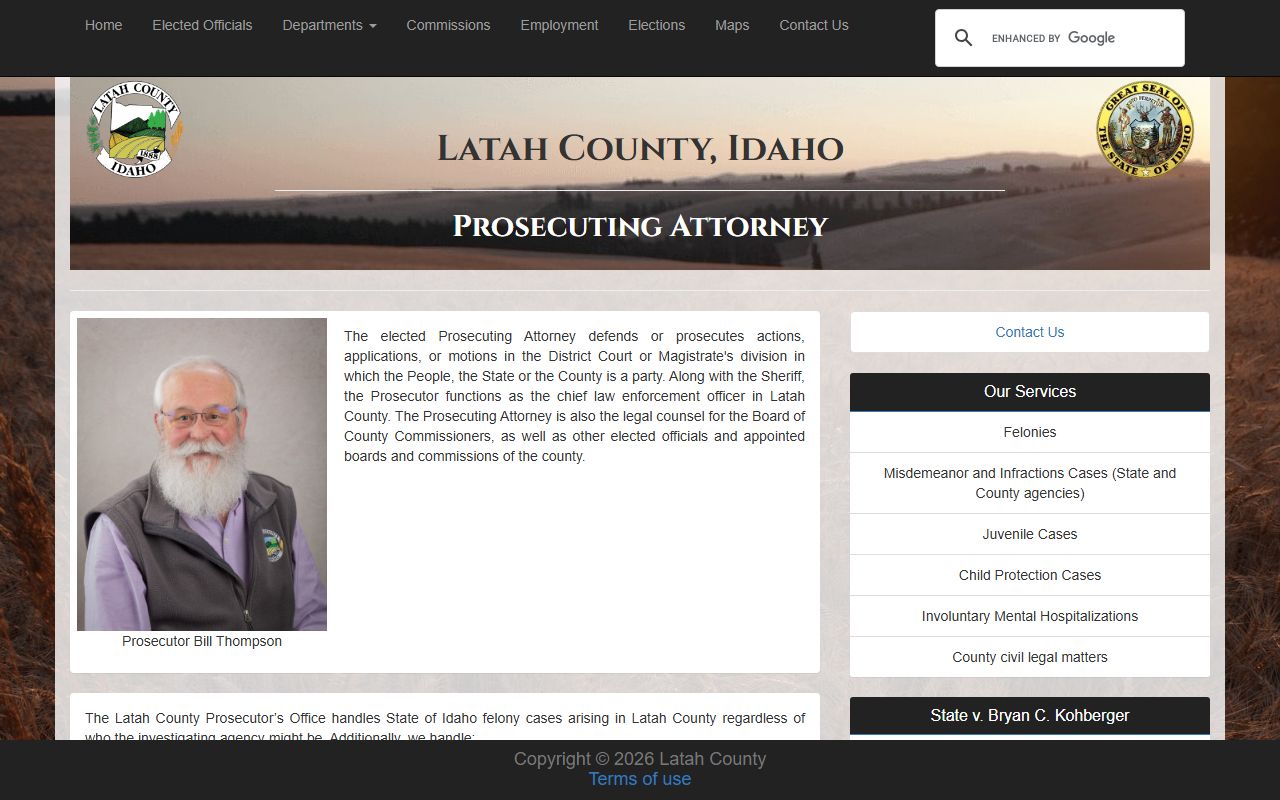
Use the prosecutor's role to understand who files or amends charges, but use iCourt and the District Court Clerk for case records and hearing information.
Latah County Charge Status
Charge status changes as a case moves. A jail roster may show a booking offense and court case number, but the formal court charge can be amended, reduced, dismissed, or resolved later. A defendant may also have a warrant or bench warrant tied to failure to appear, failure to comply, failure to pay, probation violation, or another court order. The status in iCourt should be read with the hearing history and disposition, not as a stand-alone label.
| Status | Meaning |
|---|---|
| Pending | The filed charge remains open and is not resolved. |
| Amended | The original charge or allegation was changed by later filing or court action. |
| Reduced | The charge was changed to a lesser offense. |
| Dismissed | The count ended without a conviction on that count. |
| Convicted | The person pleaded guilty or was found guilty. |
| Acquitted | The person was found not guilty. |
Bond After Latah Arrest
Bond links the jail roster to the court record. The Latah County bond page says to bring bail to the Court Clerk's Office during business hours, then bring the receipt to the Sheriff's Office. After hours, bond can be posted at the Sheriff's front window. If the person does not have cash for the bond, the county says to contact a bondsman. An extra $10 processing fee applies after court closes or on weekends, separate from the bond.
| Bond Type | How It Works | Important Limit |
|---|---|---|
| Cash bond | Full bail amount paid directly. | A receipt and sheriff processing step are part of local handling. |
| Surety bond | Bondsman posts surety under a contract. | The county does not choose a bondsman for the family. |
| PR release | Release on promise to appear. | Not described on the bond page; court order controls. |
| No-bond hold | Person is not released by paying local bond. | Can involve warrants, court order, federal, ICE, parole, or other agency holds. |
Latah County Warrants and Arrest
No official Latah County active-warrant list was found in the sheriff or Moscow Police sources. That means a court records after arrest search should use iCourt Smart Search for unsealed warrant or no-contact order information, then verify with the District Court Clerk or Sheriff's Office. The jail roster snippet found in research included bench-warrant style offense text, but one snippet should not be stretched into a countywide rule.
Warrants differ by purpose. An arrest warrant authorizes arrest. A bench warrant often follows failure to appear, failure to comply, failure to pay, probation violation, or a similar court issue. A search warrant authorizes a search and may or may not lead to arrest. A fugitive or out-of-county warrant can result in Latah holding a person for another jurisdiction.
Charges and Convictions Compared
A charge is an accusation in a court record. A conviction is the result of a guilty plea or finding of guilt. That distinction is essential after a jail arrest because the same person can have a booking record, a pending court case, an amended charge, a dismissed count, and no conviction on a specific offense.
| Issue | Charge | Conviction |
|---|---|---|
| Stage | Alleged offense after arrest or prosecutor filing. | Resolved outcome after plea or trial. |
| Meaning | Not proof of guilt. | Legal finding or admitted guilt. |
| Where seen | Roster, complaint, iCourt case, hearing records. | Disposition, judgment, sentence, criminal-history record. |
Sealed Expunged Court Records
Idaho public access has limits. Idaho Code 74-105 and 74-124 address law-enforcement, juvenile, correctional, criminal-history, shielding, and investigatory-record issues. Idaho Code 67-3004 and Idaho Courts Clean Slate Act guidance are relevant for criminal-history expungement or shielding context. A record that is sealed, shielded, juvenile, victim-sensitive, or restricted by court order may not appear in ordinary public search results.
| Record Limit | Effect | Where to Verify |
|---|---|---|
| Sealed | Hidden from ordinary public access by court order or rule. | Latah County District Court Clerk. |
| Shielded or expunged criminal history | Public criminal-history access may be limited when legal requirements are met. | Idaho State Police BCI and Idaho Courts guidance. |
| Investigatory withholding | Law-enforcement records may be withheld while an investigation or prosecution is active. | Sheriff's Records Office or agency custodian. |
Important: Court search results are not a consumer report and should not be used for FCRA-covered decisions.